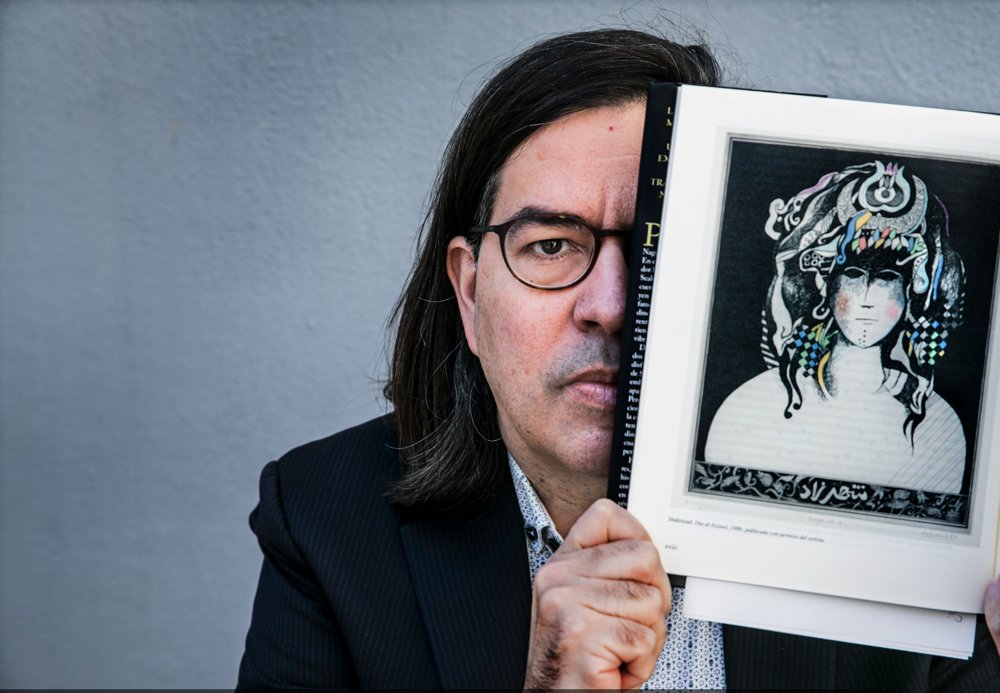
Paulo Lemos Horta
Paulo Lemos Horta is an author, translator and historian, interested in overlooked creators in literary history. He is the author of Marvellous Thieves: Secret Authors of the Arabian Nights and of the forthcoming Rotten Little Worlds: World Literature in an Age of Nationalism. He edited Aladdin: A New Translation and The Annotated Arabian Nights, commissioning Yasmine Seale’s translations and writing the introductions and commentary. With Bruce Robbins he edited Cosmopolitanisms (NYU Press, 2017).
He likes to build programs from the ground up. He founded and designed the world literature program at Simon Fraser University in Surrey, then, in September 2010, joined New York University Abu Dhabi as part of its inaugural faculty: his second start-up. There he helped design the literature and creative writing program, and he is Associate Professor of Literature and Creative Writing. He has served on the executive boards of Harvard’s Institute for World Literature, where he also teaches, and of the International Comparative Literature Association.
Contact: contact@paulolemoshorta.com · Building programs · Media, festivals and events · All books
Building programs
Horta founded a world literature program for Simon Fraser University in Canada (see the Full Program Proposal). Persuading the provincial government to make world literature a teachable major in British Columbia, like French or mathematics, proved the key. That is of a piece with his work on world literature and cosmopolitanism from below: this was not to be a boutique program for an elite in Vancouver, but a world literature from the ground up, drawn from the city’s daily multilingualism and carried back into the province’s interior by graduates certified to teach it. By design, the program was set up to educate teachers and foreign service officers, pipelines cultivated alongside the cultural industries and academia. That has let it weather recessions and cutbacks: SFU’s world literature program remains resilient, robust with majors and minors. Horta was invited to join the board of Harvard’s Institute for World Literature at its founding in 2010, and he coaxed the American Comparative Literature Association to hold its 2011 annual meeting, the most significant in the field, in Vancouver. He has consulted since on building programs in an inclusive and global way. There is more in his interviews with the North Shore News (2017) and the Vancouver Sun (2010).
The Simon Fraser University program proposal
The successful proposal, drafted by Horta as interim head, included:
- projected enrollment patterns for world literature courses, which he modeled and extrapolated from trends in foreign-language enrollments;
- the credentials and disciplines awarded;
- program aims and objectives aligned with the university’s strategic plan;
- target audiences, with content, delivery methods and curriculum tailored to meet learning outcomes;
- policies on work placements, student evaluations and faculty qualifications;
- distinctive characteristics to strengthen the program’s appeal and competitiveness, as the terms of the original bidding process required;
- program timelines and enrollment strategies for a successful launch;
- support and recognition from other institutions and regulatory bodies, easing admissions and transfers;
- an analysis of student interest and labor-market demand, to keep the program relevant.
At New York University Abu Dhabi, as a founding faculty member of the Literature and Creative Writing program, Horta has been closely involved in designing its original curriculum and its later revisions. In 2023–24 he received a Core Curriculum award for co-developing, across the divisions, the course “Democracy Reimagined” with Martin Bowen (History) and Cristina Buarque (Political Science). The New York Times visited his translation class in the university’s first year (Suzanne Daley, “N.Y.U. in the U.A.E.,” 15 April 2011).
Writing on program building
- “Cosmopolitan Protocols, Multicultural Ends? World Literature as a Programme of Study.” In Literature, Geography, Translation: Studies in World Writing, ed. Cecilia Alvstad, Stefan Helgesson and David Watson. Cambridge Scholars Publishing, 2011, 16–27. PDF
- “Whose Cosmopolitanism Is It Anyway? Musings from the Global Academy.” With Nadine Roth. New Global Studies 9.3 (2015): 267–274. De Gruyter · Issue
- “Teaching the Canon.” With David Palumbo-Liu. World Policy Journal 27.3 (Fall 2010): 11–14. PDF · Duke University Press
- “Dig into world literature, but ‘don’t toss out Shakespeare’.” Interview, Vancouver Sun, The Search, 13 November 2010. PDF
- Suzanne Daley, “N.Y.U. in the U.A.E.” The New York Times, 15 April 2011. PDF
- World Literature Full Program Proposal, Simon Fraser University (2006–07). PDF · Academia.edu
Faculty development and publishing workshops
His main goal in publishing and in academia, and part of the impulse behind Rotten Little Worlds: World Literature in an Age of Nationalism, is to demystify and democratize the means of production in literary and academic publishing. That is the point of departure for the workshops on publishing he has led in Lisbon, Barcelona and Bonn.
- March 2024Workshop leader, “How to Publish a Book with an Anglo-American Press,” University of Lisbon, for senior and junior faculty
- 4–6 June 2021Co-organizer, “Global Publishing and the Making of Literary Worlds: Translation, Media and Mobility,” a virtual conference and publication workshop for early career scholars, Princeton University
- May 2019Workshop leader, “How to Publish a Book with an Anglo-American Press,” Universitat Oberta de Catalunya, Barcelona, for senior and junior faculty and graduate students
- 2016Panelist, “Nuts and Bolts,” American Comparative Literature Association annual meeting, Harvard University: practical advice on publishing, academic and non-academic job materials, interviewing and negotiating offers, and becoming a colleague in a new workplace
- 2012Panelist, “Thinking Seriously about Pedagogy,” Institute for World Literature, Istanbul: how to organize surveys and upper-level courses in world literature
- January 2011Faculty and seminar convener, “World Literature,” a week-long NYU Faculty Resource Network seminar for faculty from majority-minority colleges, San Juan, Puerto Rico