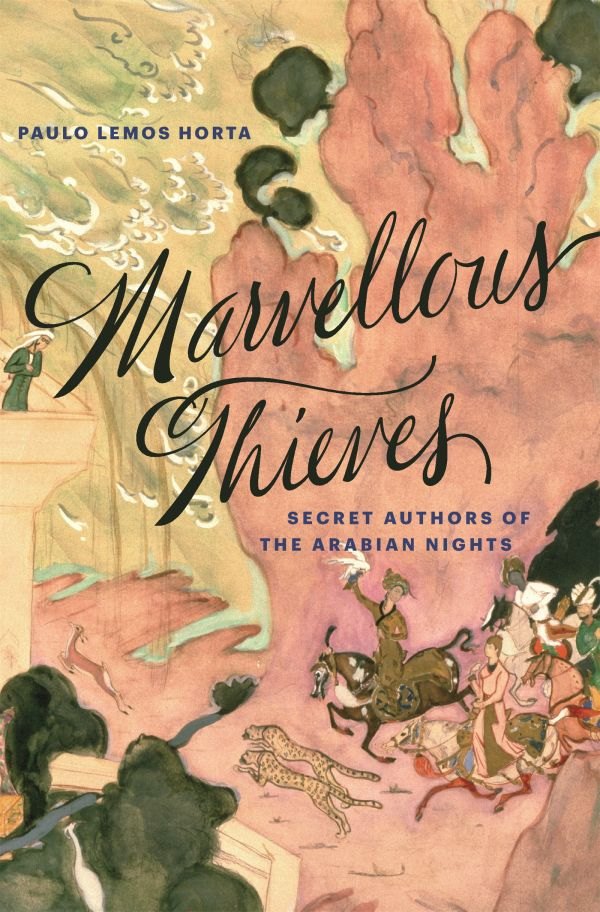
Marvellous Thieves
Paulo Lemos Horta · Harvard University Press, 2017 · Paperback 2019
For more than three centuries, translators of the Arabian Nights have accumulated prestige, reputations and even knighthoods, and have been credited as the authors of tales and commentaries added to the Nights in translation; in Marvellous Thieves, Horta at last uncovers the agency and history of the local storytellers, guides and collaborators the Orientalists stole from.
“In “Marvellous Thieves,” a nimble 2017 study of the “Arabian Nights” and its provenance, Paulo Lemos Horta notes that Diyab, prior to recounting “Aladdin” to Galland, had attended the royal court, in Versailles, with Lucas (who made him robe up in mock-Oriental garb), and admired the bejewelled splendor of the women—a Western detail that gleams in the Eastern princess of “Aladdin.” Thus do cultures feast upon one another.”
“Paulo Horta has uncovered a mass of fresh evidence about key figures in the making of the Arabian Nights and communicates his startling findings with a storyteller’s verve, raising many fascinating issues about the interplay of invention, imitation, translation, and plagiarism, and probing the vexed effects of the imperial gaze and the acquisition of local expertise and languages. In Marvellous Thieves, Paulo Horta has written a highly entertaining, attentive, and scholarly work of literary detection.”
“Marvellous Thieves, which draws on hitherto neglected sources, is a brilliant, fluent and original work of literary scholarship.”
“L’approche de Paulo Lemos Horta est extrêmement originale.”
Paulo Lemos Horta’s approach is extremely original.
“This vivid, intellectually lively and revelatory book gives complex answers – and brilliant stories of literary sleuthing – to a couple of seemingly simple questions: who wrote Arabian Nights?”
“Horta reaches the astonishing conclusion that Diyab was not simply a passing storyteller to Galland’s master translator, but a “crucial contributor to the networks of creativity” that brought the Arabian Nights into European culture.”
“This work is a major contribution to the study of the complexities inherent in translating such a masterpiece.”
“This fine book … cogently probes an influential period in the knotted and at times sordid history of the “Arabian Nights,” serving as a fine example to those unraveling this promiscuous and forever malleable set of stories.”
“[Horta’s] fascinating search for the origins of The Arabian Nights as it exists today reveals a multitude of storytellers nearly as colorful as Sinbad or Aladdin.”
“An insightful examination of a significant literary work and the fraught complexities of translation.”
“… underhållande och väl underbyggda …”
… entertaining and well-founded …
“The translators Horta recounts were unquestionably thieves—of each other, of their sources and interlocutors, of their own personal encounters in Arab, Persian, and Indian cities they visited. But Horta makes a persuasive case that each man’s acts of plagiarism, theft, recreation, and simple fabrication are nearly as interesting stories as the ones they were toiling to bring to Western readers. Each man, whether Antoine Galland and Hanna Diyab or Richard Burton, was seeking to make his mark upon the world and preserve literature. There are numerous books recounting the problematic legacy of colonial translators, ethnographers, or simple civil servants like Torrens, but that book is not Marvellous Thieves and Horta has given readers a highly enjoyable account of the story behind the Thousand and One Nights.”
“Marvellous Thieves is an exciting reading experience that helps us reconstruct a biography of one of the oldest romances in literary history.”
“In writing a biography of 200 years of Nights' translation, with its multiplicity of voices, sources, contexts and prejudices, Horta has breathed life into another great story to emerge from the Thousand and One Nights.”
“Marvellous Thieves is a major contribution to the study of the Arabian Nights as it makes use of overlooked primary sources such as Diyab’s memoir.”
Best non-fiction book of the year, North Shore News, 2017
Translation rights sold in Turkey
- The New Yorker, “Wish List,” Anthony Lane, 24 May 2019
- All About History, “Scheherazade and Shahryar,” 25 April 2019
- ArabLit, “Forthcoming: Translation of Memoir by ‘Aladdin’-teller Hanna Diyab,” 27 May 2019
- Time, “Was Aladdin Based on a Real Person? Here’s Why Scholars Are Starting to Think So,” Olivia B. Waxman, 23 May 2019
- New York Post, “Experts believe Aladdin may actually be based on a real person,” Chris Perez, 23 May 2019
- Review of Middle East Studies 53.2 (2019), Melinda Cohoon
- Translation and Literature 28 (2019), Claire Gallien
- Middle Eastern Literatures 20.3, Philip Kennedy, 18 December 2018
- Recherche littéraire / Literary Research, Xavier Luffin, Summer 2018
- Victorian Studies 60.4, Ali Behdad, Summer 2018
- Marvels & Tales 32.1 (2018), Nivair Gabriel
- The Hindu, “Travelling Tales,” Uma Mahadevan-Dasgupta, 9 December 2017
- Dawn, “A Thousand and One Voices,” Aqsa Ijaz, 3 December 2017
- Ajam Media Collective, “Who ‘wrote’ Aladdin? The Forgotten Syrian Storyteller,” Arafat A. Razzaque, 14 September 2017
- The Telegraph (Kolkata), “Living Networks,” Sujaan Mukherjee, 17 November 2017
- Commonweal, “One Thousand and One Appropriations,” Celia Wren, 8 May 2017
- Al-Ahram Weekly, “Marvellous Thieves?,” David Tresilian, 18 October 2017
- Times Literary Supplement, Bruce Fudge, 11 July 2017
- The National, “Book review: Marvellous Thieves reveals local voices and sources of The Arabian Nights,” Clare Dight, 16 March 2017
- Svenska Dagbladet, “Litterär skatt med en sagolik historia,” Carl Rudbeck, March 2017
- The Wire, “The ‘Marvellous Thieves’ of the Arabian Nights,” Anu Kumar, 18 February 2017
- Times Higher Education, “The tales’ many hidden tellers,” Shahidha Bari, 2 February 2017
- Library Journal, starred review, Ali Houissa, 1 February 2017
- PopMatters, “The Translators of ‘Thousand and One Nights’ Were Unquestionably Thieves,” Matthew Snider, 1 February 2017
- Literary Review, “Stealing with Style,” Robert Irwin, February 2017
- The Wall Street Journal, “Aladdin’s Many Fathers,” Charles Shafaieh, 13 January 2017
- Scotland on Sunday, “One Thousand and One Routes from Aleppo to Aladdin,” Stuart Kelly, 1 January 2017
- Publishers Weekly, 14 November 2016
- Kirkus Reviews, 20 October 2016
- Excerpt: The Penguin Digest, 8 January 2018
- Excerpt: The Wire, “A Syrian Storyteller in Versailles,” 25 August 2017
- Excerpt: Mumbai Mirror, “Anglo-Indian Nights,” 13 August 2017