Who created Aladdin?
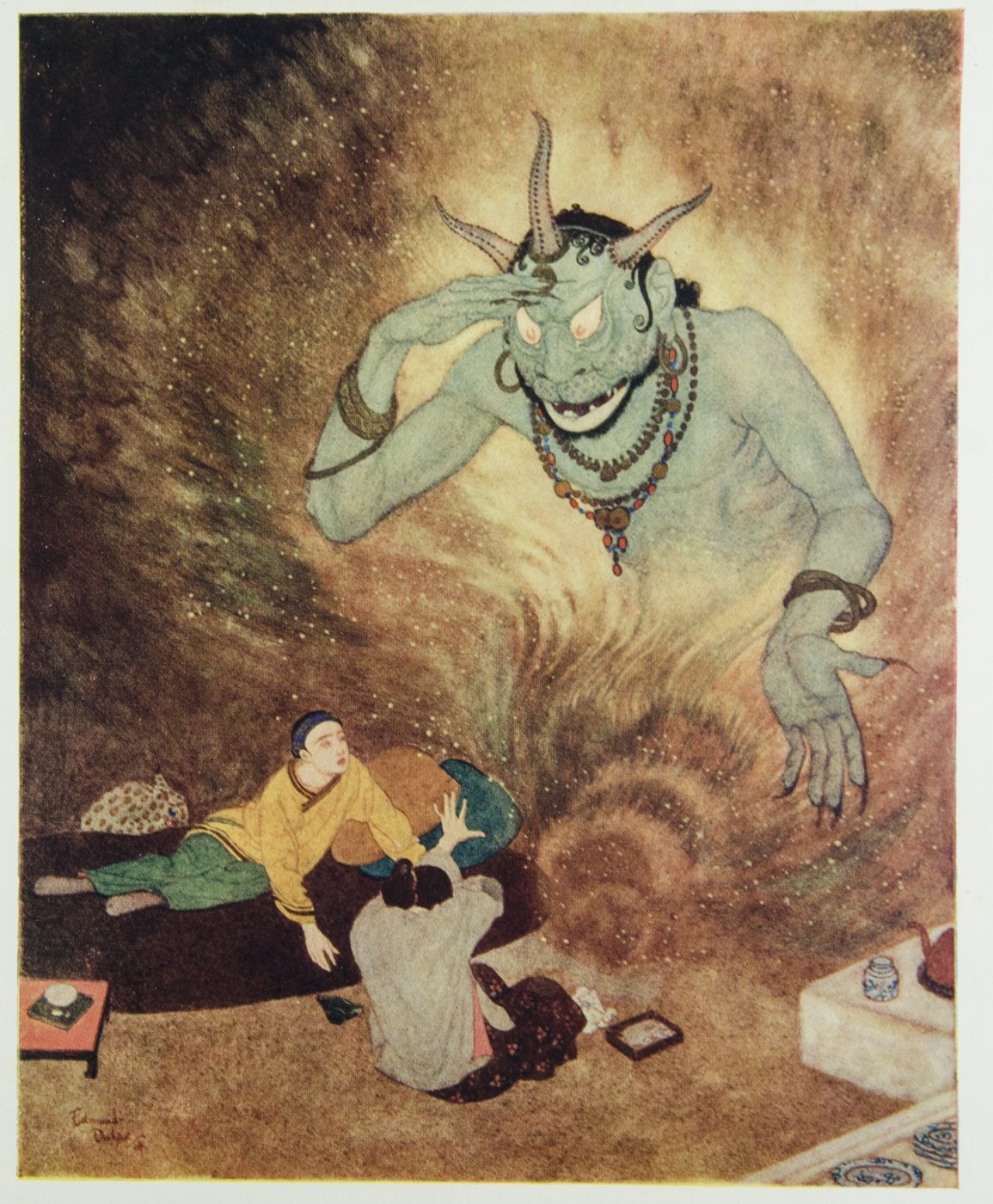
“Aladdin” first appeared in Antoine Galland’s French Arabian Nights, and for three centuries it was credited to Galland. No earlier Arabic manuscript of the tale has been found. Galland had it from the Syrian storyteller Hanna Diyab in 1709. Since Marvellous Thieves (2017), Paulo Lemos Horta has argued that Diyab was its creative author, and that the tale was shaped as much by Diyab as by Galland.
“While once regarded as only a supplier of raw material to the creator of the Arabian Nights in French literature, Diyab now emerges as an author in his own right.”
Marvellous Thieves (2017), p. 86
“Horta's own magic in reading Diyab's recently discovered memoir is not to presume that Galland embellished the tales told by Diyab thanks to his knowledge of Arabia but, rather, to wonder whether it was Diyab who drew on his own wanderings from Aleppo to Paris to colour the tale. In saying so, Horta overturns assumptions of authorship: Galland – and later, Lane and Burton – become collaborators instead.”
More in Horta’s words (1)
“The so-called orphan tales … can no longer be seen as authorless. Their origins lie not only in the French literary practice of Galland but in the imagination and narrative skills of the Syrian traveler who first told them in 1709.”
Afterword to Diyab’s Book of Travels (2021), p. 319
More from critics and scholars (3)
“Diyab has long been credited only with offering skeletal outlines of these stories, with Galland elevating them to the richly detailed versions bearing his name. Mr. Horta, in comparing Diyab’s recently discovered memoir, whose complex structure bears similarities to the “Arabian Nights,” with Galland’s much drier personal writing, suggests, however, that the Syrian’s voice may be more present than previously believed.”
“Horta reaches the astonishing conclusion that Diyab was not simply a passing storyteller to Galland’s master translator, but a “crucial contributor to the networks of creativity” that brought the Arabian Nights into European culture.”
“Most of all, [Marvellous Thieves] tells the story of Diyab, a Maronite Christian who went into business, travelled to the court of the “Sultan of France” with hopes of being his Arabic librarian, told stories, was impressed and impressive and was shunned, and created the tale countless Scottish families watch as pantomime.”
Academic priority
- January 2017Horta, Marvellous Thieves (Harvard University Press)
- 2021Horta, Afterword to Diyab’s Book of Travels (2021)
Global mainstream impact
- 1 January 2017Stuart Kelly, Scotland on Sunday
- 13 January 2017Charles Shafaieh, The Wall Street Journal
- 2 February 2017Shahidha Bari, Times Higher Education
- 16 March 2017Clare Dight, The National